 |
| Andrew Cowdell, The way home, carbon and watercolour |

Showing posts with label monochrome painting. Show all posts
Showing posts with label monochrome painting. Show all posts
Monday, 17 July 2017
Andrew Cowdell, The way home, 2017

Tuesday, 6 June 2017
Andrew Cowdell, Dawn, 2017
 |
| Andrew Cowdell, Dawn, 2017, carbon and watercolour, 7 x 9" |
These early morning sessions enable me to capture that sense of stillness when trees and fields are wet with the morning dew and the light of the breaking day has not reached its full intensity. The atmosphere created is both romantic and realistic.
Wednesday, 25 May 2016
Andrew Cowdell, Two crows at dawn, 2016
 |
| Andrew Cowdell. Two crows at dawn. 2016. Oil on linen. |
My fascination with darkness requires an idea of light. In Two crows at dawn, the beauty of morning’s first light is matched by the eeriness generated by the arresting, black, thorn-like tangle of trees within the hedgerow. This traumatised landscape is a realm that snags, bites and troubles, and yet still invokes the pastoral dream of natural tranquillity. Beauty is envisaged here as William Blake’s “marriage of the contraries”, dependent upon both positive and negative aspects of existence.
The darkness of the setting serves as a representation of the Other, or the Unknown, which subtly imbues the scene with a sense of the supernatural. In subverting the aesthetic certainties of the usual green and pleasant Berkshire countryside, I am simultaneously identifying with both the picturesque and sinister presences within it. Presences which may include fiscal forces churning and poisoning the landscape; evidenced in the painting by tyre marks along the field margin. Alternatively, ‘absences’ may refer to the slow grinding away of our flora and fauna as species are lost; the two sentinel ‘carrion’ crows sent forth by vengeful nature. This landscape may even have its phantoms, lying or waiting where they fell or were taken at some unspecified time in history. And yet, all this darkness depends on the corresponding light of dawn as the beauty of the landscape reawakens.
But ultimately, I shall leave it to your own interpretation.
Tuesday, 29 March 2016
Andrew Cowdell, Clamour over Hermitage, 2016
 |
| Andrew Cowdell, Clamour over Hermitage, 2016, oil on linen |
In this monochrome oil painting, a clamour of rooks enhances the beauty of the Berkshire landscape made desolate by the damp, overcast weather.
In the following extract the French poet Arthur Rimbaud describes his affection for these raucous birds:
Lord, when the meadowland is cold,
and when in the downcast hamlets the long Angeluses are silent..
down on Nature barren of flowers let
them sweep from the wide skies, the dear delightful rooks.
from The Rooks (Les Corbeaux)
by Arthur Rimbaud, 1854-1891
Saturday, 19 March 2016
Mark Tansey, The Innocent Eye Test, 1981
 |
| Mark Tansey, The Innocent Eye Test, 1981 |
In this monochrome painting, a cow stands in front of Paulus Potter’s The Young Bull, 1647, whilst human experts wonder if it can distinguish artifice from reality.
The focus of the experiment relies upon Potter’s highly representational painting style, and its power to convince the compliant animal. In the background, men of science make notes whilst standing with their backs to Monet’s Grainstack. They are scrupulously observing what they see, just as Potter would have done when painting his cows. Monet’s work of Impressionism is rejected as unreal.
Friday, 18 March 2016
Andrew Cowdell, The Terrible Beauty of a Winter's Day, 2016
 |
| Andrew Cowdell, The Terrible Beauty of a Winter's Day, oil on linen |
With only the corvids for company and little in the way of sunshine, the terrible beauty in my surroundings inspired the subject and title to this monochrome oil painting. The corvids I have painted are specifically rooks, which are still often spoken of under the general term ‘crow’. Many times have I observed these eccentric and ragged birds as they twist and tumble through the skies above their communal roosts in the woods. However, once out across the fields these rooks adopt a steady undeviating flight as they commute to their feeding grounds. It may be to rooks that the old saying ‘as the crow flies’ refers.
In the following extract James Thomson relates his meeting with rooks during a bygone winter:
See, Winter comes to rule the varied year,
Sullen and sad, with all his rising train—
Vapours, and clouds, and storms. Be these my theme,
These, that exalt the soul to solemn thought
And heavenly musing. Welcome, kindred glooms!
…But chief the plumy race,
The tenants of the sky, its changes speak.
Retiring from the downs, where all day long
They pick’d their scanty fare, a black’ning train
Of clamorous rooks thick-urge their weary flight,
And seek the closing shelter of the grove.
from The Seasons: Winter
by James Thomson, 1700-1748
Friday, 20 November 2015
Andrew Cowdell, Betty, 2015
 |
| Andrew Cowdell, Betty, 2015, oil and gold on linen |
Betty Grable danced, sang, and acted her way through the 1930s to become the biggest box office star of the 1940s. She had honed her famously gorgeous legs to the extent that her studio reportedly insured them for $1 million with Lloyd’s of London. The same legs were soon captured in the most iconic photo of bathing-suit-clad Grable, back to the camera and glancing over one shoulder. As most of her popular roles occurred in the early 1940's American servicemen voted Grable their favourite pinup, and painted her image on the sides of bomber planes.
Tuesday, 13 October 2015
Rita Hayworth: The Lady
 |
| Andrew Cowdell, The Lady, 2015, oil and silver leaf on linen |
The Lady is a silver leaf oil portrait of Elsa (Rita Hayworth) in The Lady from Shanghai (1948). Director Orson Welles stars alongside his estranged wife Hayworth before finalising their divorce. In taking the role of scheming femme fatale Elsa, Hayworth’s image was to undergo a drastic change. She allegedly wanted to break from the character she had become so identified with in her previous hit movie Gilda (1946), so she had her famous long hair cut and bleached blonde. Welles was held responsible for the controversial look, as Hayworth later recalled Columbia Pictures president Harry Cohn saying “He’s ruined you - he cut your hair off!”
Wednesday, 16 September 2015
Fashion and Painting: a symbiosis
 |
| Andrew Cowdell, Faux noir, oil on canvas |
Faux noir is one of my first large-scale monochrome oil paintings. It is a figurative composition exploring the language of clothing, a dialogue which can subtly emphasise qualities of personality and sentiment. The symbiosis of fashion and painting is a theme I enjoy seeking out in galleries, especially those containing portraits of the Second Empire and Impressionism. As art inspired fashion, so fashion served as a muse for art.
Thursday, 21 May 2015
Eugene Carriere, Her Mother's Kiss, 1899
 |
| Eugene Carriere, Her Mother's Kiss, 1899 |
Eugene Carriere (1849-1906) developed his own Symbolist style using monochrome or low-key painting techniques. His colours tend towards neutral browns and greys with strong contrasts of light and shadow. Subjects are in a ghostly mist ‘like those seen a few paces away in the London fog’.
Friday, 24 April 2015
Andrew Cowdell, The Return, 2014
 |
| Andrew Cowdell, The Return, oil on canvas |
This monochrome oil painting takes its inspiration from the movie Laura (1944). The concept explores the theme of the ‘magical portrait’ which characterises many noir thrillers and gothic melodramas of the 1940s. The gothic exists in the core of the portrait not only in its classical style, but also in its true representational meaning; it is a ‘symbolic body’ replacing a ‘mortal body’. In choosing this concept I am exploring the same underlying theme of presence and absence as dominates the film’s narrative.
Saturday, 18 April 2015
Léon Spilliaert, Vertigo, 1908
 |
| Léon Spilliaert, Vertigo, 1908 |
At first glance the haunting black-and-white landscapes of Léon Spilliaert resemble abstract works of art. In Vertigo the hooded female echoes symbolist imagery of vampires, witches and femme fatales. Will she fall or throw herself into the dark void that awaits her under the steeply plunging steps?
McClelland Barclay, 1891-1943
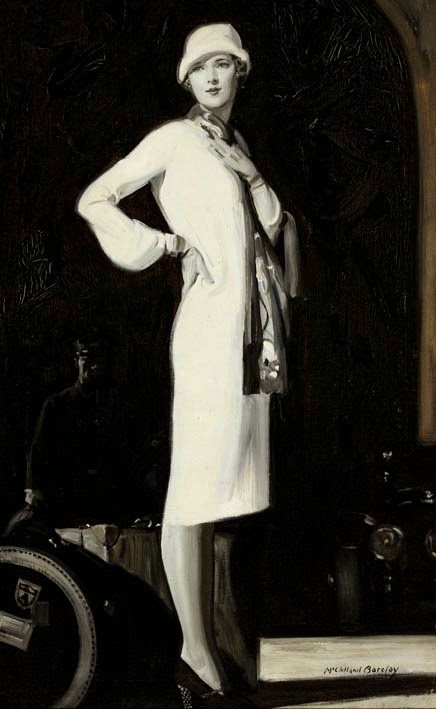 |
| McClelland Barclay, 1891-1943 |
Hello everybody.
This monochrome painting is by American artist McClelland Barclay (1891-1943). Illuminated by a low sun, the elegant lines of the subject contrast superbly against a shadowy background. By adding umber tones to his palette Barclay has created a scene imbued with convincing warmth.
Barclay began painting movie poster art for Hollywood studios during the 1930s, and was considered a superstar in the film industry. Sadly, on July 18, 1943 he was reported missing after the U.S.S LST 342 he was aboard was torpedoed in the Solomon Islands.
Wednesday, 15 April 2015
Andrew Cowdell, The allure of night, 2014

Taking my inspiration from the 1946 film noir The Killers, this monochrome oil painting fuses various elements of the dark narrative to represent a conceptualized image. Ava Gardner as Kitty Collins is the ultimate femme fatale; sultry and sardonic, she at once embodies everything that is beautiful and terrible. Kitty's lover, Ole, takes the rap for her stolen jewellery and is sentenced for a three-year prison term. Ole's cellmate Charleston passes the time by gazing at and studying the stars. When Charleston describes a bright star in the night sky, Ole is thinking of Kitty:
"You see that bright star in the center...brightest star in all the heavens. Only it's so far away, it don't seem like it."
But Kitty hasn't written or visited Ole in prison during his entire incarceration. Kitty dominates the fate in store for those who embark upon nocturnal adventures. Her mysterious attraction corresponds to the unfathomability of the night itself.
Thank you for reading.
Subscribe to:
Posts (Atom)